Aligning Profit and People: The Secret to Resilient Social Media
A journalist gets blocked by Bluesky, but her Bluesky posts can still be seen via Blacksky. This apparent contradiction goes to the heart of resilient social media, where businesses must support their users to stay in business.
(You're reading a draft post, published using the permanent versions pattern, where I publish a string of versions as I develop my thoughts in the hope of collecting constructive criticism and ideas along the way. Links to the latest and previous versions, if any, are in the footer.)
It was quite a bombshell from Sarah Kendzior, a highly respected American journalist who has been chronicling the rise of the MAGA right since at least 2020's Hiding in Plain Sight:
"I have been blocked by Bluesky" - Sarah Kendzior on X
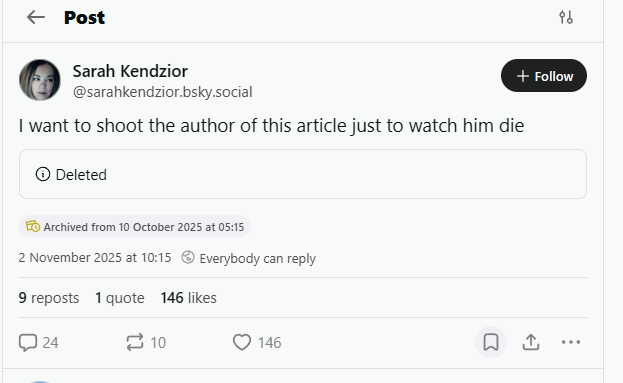
What on earth could she have done? It was pretty easy to find out, explained Sebastian Vogelsang, creator of the Flashes app: "you can still see her post on Blacksky".
And sure enough, there it is:
!
But how can I see this if Bluesky banned her? And what is Blacksky, and why do I think it points the way to the resilient social media Europe needs to reinforce its digital sovereignty?
Blacksky, for example
Blacksky is a harbinger of what the ATmosphere could be.
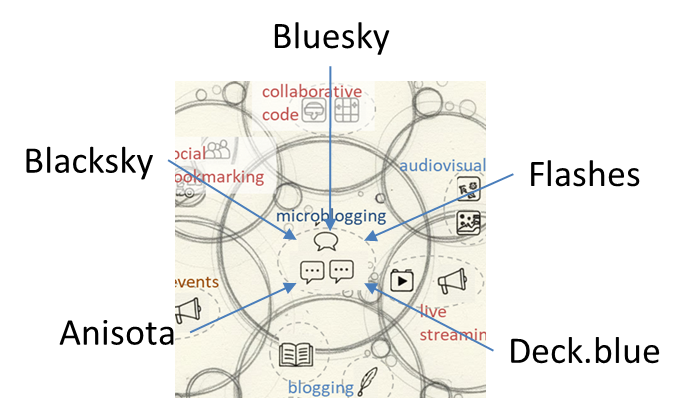
The ATmosphere is the social media universe underpinned by the AT protocol, which also underpins Bluesky, Flashes and much more. Like Bluesky, Blacksky is a micro-blogging app which uses the "Bluesky lexicon", so they belong in the same family within the microblogging circle in the diagram explained in my last post:
!
Moreover, as you can see above, Blacksky presents content more-or-less identically to Bluesky, in contrast to some other apps in the same family:
!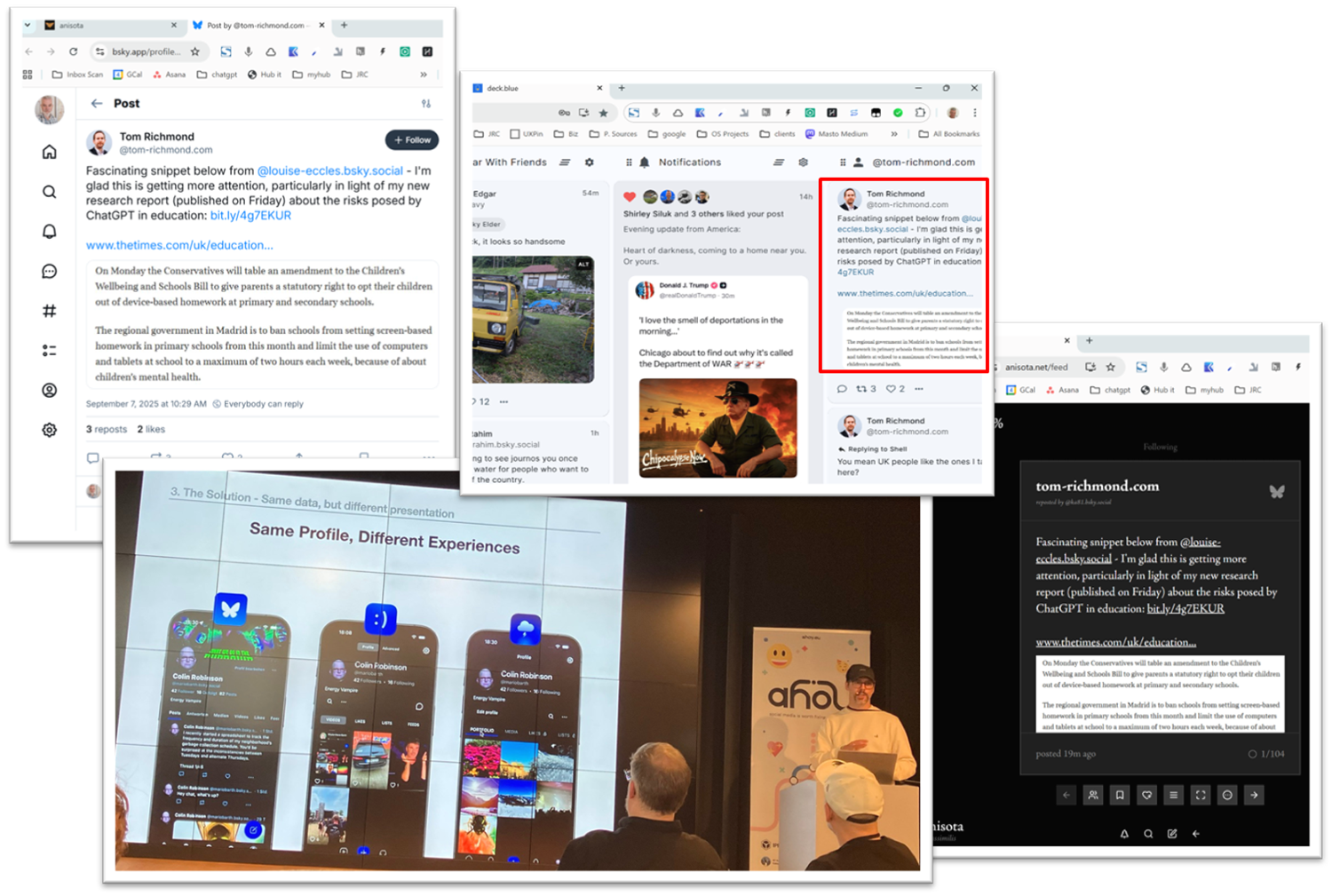 Clockwise from top left: The same post viewed via the Bluesky app, deck.blue and anisota, plus Sebastian Vogelsang's presentation of Flashes from the Ahoy! conference earlier this year (see Feel the ATmosphere: it's 1995 all over again).
So, if Blacksy presents the same content in the same way as Bluesky, what's the point of it?
Community-driven social media, global conversation
Blacksky is in fact an entirely different app, written in a different programming language and - crucially - provided by a company which provides its own moderation services. So while the Bluesky Company found that Sarah Kendzior broke their Terms of Service (of which Cory Doctorow is not a fan), Blacksky did not, which is why you can still see her content via their app(1).
Blacksky is an app run by a community for a community. But ... they're not cut off from the global Bluesky conversation
As Blacksky founder Rudy Fraser put it recently, he first created the Blacksky algorithm "so that people could choose a different kind of algorithm", and followed it with a Blacksky moderation team, so users can choose "a set of self-governance and moderation tools that are not someone else's. You're not dependent on a well-meaning corporation or an antagonistic corporation or a nonprofit that isn't of and by your community" (Rudy Fraser, interviewed in Revolution.Social).
Blacksky is an app run by a community for a community. But while its policies and practices reflects the needs of its community members, they're not cut off from the global Bluesky conversation - they just see a different view of it.
Aligning business model and community values
Rudy doesn't have the same anti-corporate focus you see in a lot of alternative social media spaces: "My influences and thoughts come from Black folks always having their own magazines, their own TV stations. It's still corporate... but it was for us. The authority is actually okay if you trust the authority and if there's ways to hold the authority accountable".
Accountability is key. And that accountability stems from the AT protocol's open nature. Because while Blacksky is built for a specific community, they're building an open-source toolkit which anyone can use: "we want to be able to provide ways for communities to spin up all this infrastructure on their own".
the company's business model must be aligned with the community's interests if it is to succeed.
That's not just because he wants other communities to succeed - it's critical to Blacksky's success as well. If, for some reason, the Blacksky community didn't like the direction the Blacksky company was taking it, the community could simply build another version using the tools and move across to it. The company's business model must be aligned with the community's interests if it is to succeed.
A resilient European online public sphere
Imagine if there were dozens or hundreds of Blacksky-like community-focused apps run by companies around the world, and more people using them.
The resulting ATmosphere would be composed of:
- different apps developed by different companies in different countries, all interoperating freely in a global conversation
- but each offering something unique: maybe a "slow social" interface like Anisota or the Instagram-inspired interface of Flashes; perhaps a different approach to moderation, reflecting the needs of the apps' community; or reflecting a particular legal environment; or all three
- each app is responsible for the content it displays, and answers to the laws of the country it is run from - there's no such thing as a social media company which is "too big to regulate"
- power would be distributed, not concentrated in a handful of US and Chinese companies, so there's no such thing as a company which can "ban someone from social media".
The only reason Sarah Kendzior's suspension(2) really matters, after all, is because 99% of the people using a Bluesky app currently use the Bluesky Company's app, giving them outsized power in the ATmosphere.
This does not seem to be what they want - they did, after all, design the technology with "the organisation as future adversary" in mind, to render the company and the ATmosphere "billionaire-proof". But billionaires aren't the only threat, as the US Congress recently made clear:
"remove all posts that have celebrated the political assassination of Charlie Kirk... My Committee will be a leading force in the righteous endeavor... the vigilant maintenance of appropriate behaviors within our publicly accessed social media" - Congressman Clay Higgins (R-LA), Chairman, Federal Law Enforcement Subcommittee
We now have the technology to ensure that no one company has a stranglehold on our collective conversation, wherever in the world they are based. But it is actually impossible for the Bluesky Company to make that a reality by themselves, short of actively driving their users away users to alternatives like Blacksky.
It's up to us to take what Bluesky and Blacksky have built, and build further. Which is why I'm looking forward to what Sebastian has to show us in Berlin next week.
Endnotes
- Note that Sarah Kendzior's content is still stored on a personal data server (PDS) hosted by the Bluesky Company - hosting data and displaying it in an app are two entirely different services. I suspect she'd now move her content somewhere else if she got the chance.
- FWIW, Sarah Kendzior's post was unequivocally against the letter of the Bluesky Company's Terms and Conditions, which they take very seriously, particularly the bit about posting death threads. But it was also clearly not a death threat: she "referenced the “I shot a man in Reno just to watch him die” lyric of “Folsom Prison Blues” in response to a terrible Wall Street Journal article saying that Johnny Cash was uncool. I quote-tweeted the article and everyone understood the reference. There was no outcry" (Sarah Kendzior's Substack).
Revision Notes: This is one of this wiki's pages managed with the permanent versions pattern described in Two wiki authors and a blogger walk into a bar… . Version control:
- this is version: 2
- this is the current version: rudy, blacksky & resilient social media
- here is the previous version: rudy, blacksky & resilient social media 1