"We can just do things": five days in Vancouver
Key topics from AtmosphereConf 2026: making the web social; streams, gardens and communities; science, AI, news and more.
The months preceding AtmosphereConf (25-30 March) were an overwhelming blur of announcements, launches, and new ideas arriving faster than I could read them. The normal pre-conference acceleration, perhaps, but more intense than anything I'd seen.
When I got to Vancouver, I found plenty of people who felt the same way. But we didn't know what we were in for. In retrospect, the preceding months had been a slow-paced appetiser.
we didn't know what we were in for
Back in Brussels last Monday, I needed two full days to just read through my notes and a small fraction of the material I'd bookmarked, posts I'd saved and photographs I'd taken, trying to get my thoughts into some sort of order.
And by the time I published my workshop recap, the onslaught had restarted: as I write these words I've Queued at least half a dozen "What I learned at AtmosphereConf" blog posts. But before I read and curate them to my Hub (they'll be tagged #atmosphereconf2026 and #recap), I need to add to them by getting down my own thoughts, for my own benefit if no one else's.
So this is not an exhaustive overview of a five-day conference. Instead, it's a quick recap of my path through it, organised by the themes I perceived, with some links to help you discover more. I hope you'll find it useful.
(Note: This is version 1 - I'll add more as I plough through my reading queue. Version control and more details in the footer.)
Web, meet Atmosphere: let's save the world
Before Vancouver I published a couple of blog posts exploring how integrating the Atmosphere with your website allows you to create better online communities with simpler code, in the process making the Web social again and turning it into the largest Atmosphere recruitment surface one could possibly hope for.
So maybe I was always going to find this idea resonating throughout the conference, even if it didn't for anyone else. But perhaps it did: while I was writing the theory, Boris and his friends were putting it into practise: integrating both streaming service Stream.place and event site Atmo.rsvp with the conference website.
unlocking cross-tool integrations which are impossible using yesterday's siloed walled gardens.
So what? Anyone who's embedded a YouTube video knows that it's not unusual for a website to integrate other services. The key difference is that users access these different apps with the same Atmosphere account, unlocking cross-tool integrations and conversations which are impossible with yesterday's siloed walled gardens.
"We can just build things"
Moreover, according to many people I met in Vancouver, these sort of integrations are simple: atproto is easy to work with.
Online tools for better events
And nowhere was that more obvious than in the online tools developed by the community to make the physical event more effective, something dear to my heart since 2002.
A few days before the event, for example, Brookie unveiled "You and Me" - a simple QRcode-based web app which allows two Atmospherians meeting face to face to connect online.
!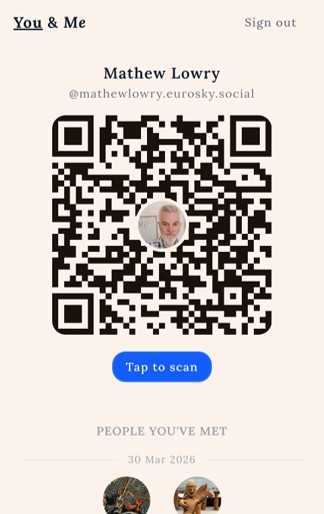 Scan, connect, collect
Apparently created in one day, YouandMe was for many people the most popular app at the conference. Pretty soon Business Goose launched Superconnectors (below) to visualise the connections and create a leaderboard...
!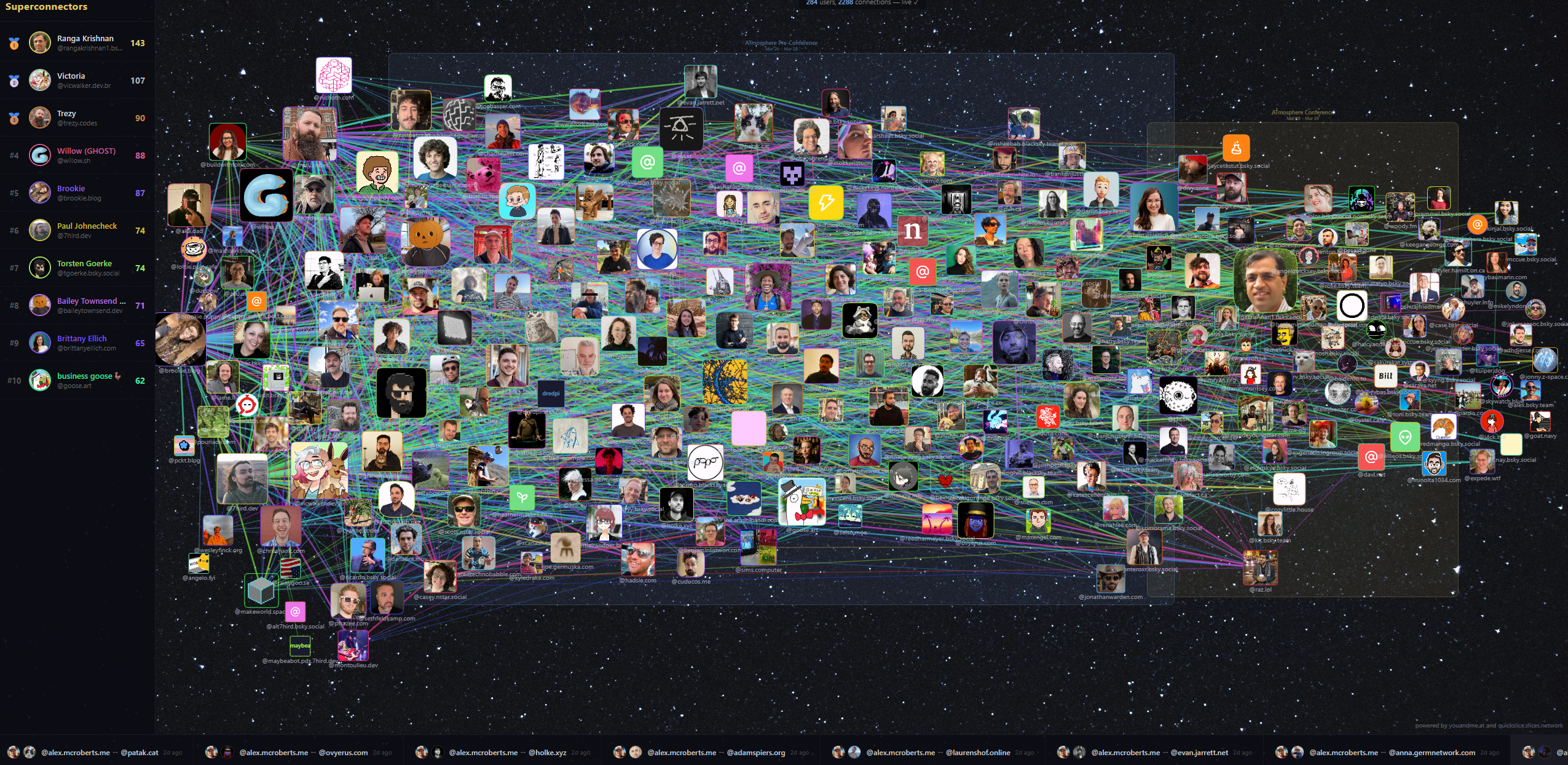
... while the conference website integrated it into its personal profiles. By the time we headed home "nearly every attendee had made at least one connection. And together, we made over two thousand connections in just the span of a four day conference" - State of the Atmosphere (CONF 2026) (Brookie).
collaboration just emerges
As the developer of a similar service put it, collaboration just emerges.
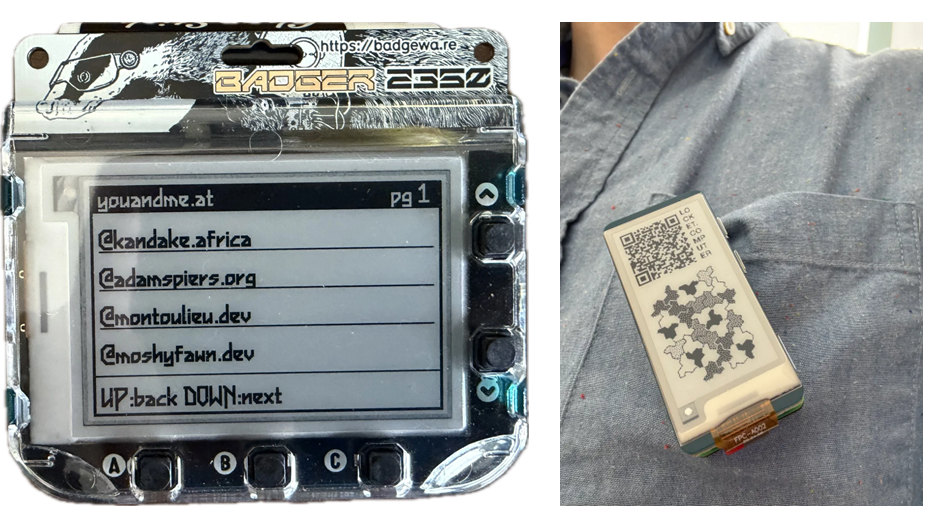
More: Two things I didn't see were Bailey's badger badger badge (below left), a tiny computer hanging from his conference lanyard, displaying a guest book showing all who connected with him via youandme.at; and Jim's version (below right), which also "creates a unique image based on your connection".
!
Creative freedom, malleable software
This creative freedom wasn't discovered in Vancouver: the community's tagline, after all, is "We can just do things", reflecting the ecosystem's permissionless nature.
For me, however, the event was also a first glimpse of "malleable software", where people can vibe code their own app, pull in Atmosphere data as required and use the cross-app integration I mentioned earlier. This makes the dream of ridiculously easy group formation, first posed in 2002, a little closer: any community can now create the space it needs, and then iteratively improve it as the community's needs evolve.
From streams to gardens
This freedom to innovate unlocked a lot of ideas during the What futures can we build together? workshop on Thursday, where we workshopped new ways social media could look and behave. I found myself in a group headed by Habitat (see Communities, next), where I suggested we integrate flow and stock content (2010), allowing communities to seamlessly extract and accrete a body of slow-moving wisdom (stock) from its fast-moving chatter (flow).
This is not a new idea: FAQs, after all, were invented specifically for this purpose in Usenet forums, years before the first web browser. But somehow, in the rush to mobile-first microblogging, we've lost that connection between flow and stock.
And then literally a few minutes after the workshop, Adam Schwab showed me a demo of exactly what I was looking for:
This is very relevant to web/atproto integration because stock content is generally published on websites, while flow generally streams past in social media apps. But these two forms of knowledge should be complementary, making each other more valuable, so the quicker communities can transform their flow into stock, the faster we will develop better collective intelligence.
these two forms of knowledge make each other more valuable
More: This idea was to resurface throughout the conference, albeit clothed in the slightly younger Garden and Stream metaphor (2015) metaphor:
- @Ezra revisited it in the light of the ATprotocol just before the event
- Ronen Tamari referenced it in his #ATscience presentation of Semble, a curation tool which serves as a handy fulcrum for managing knowledge picked from the stream and collectively transforming it into something more valuable
!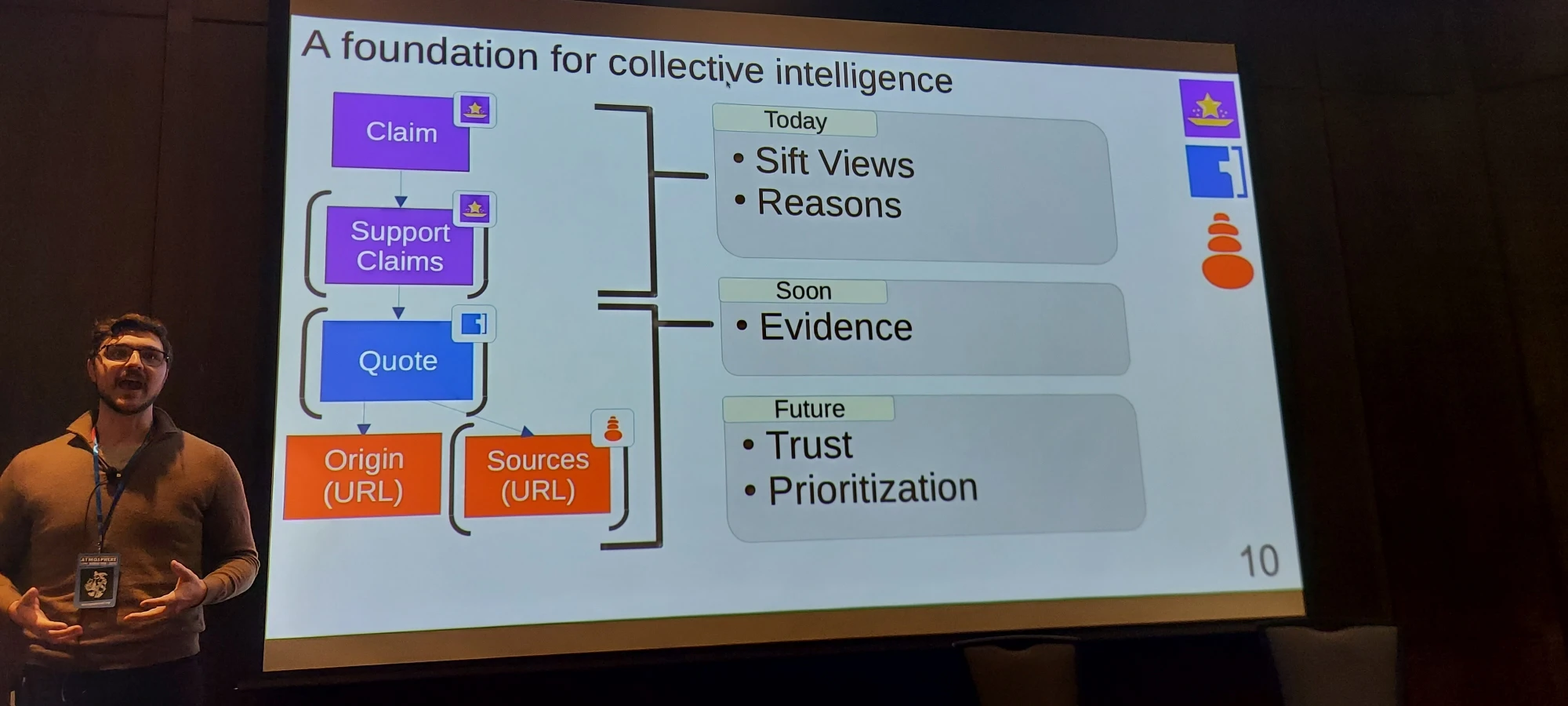
Also related: Alex Garcia-Joyner's presentation (above) of Viewsift, an evidence-based social platform designed to foster understanding and reduce hostility on controversial topics, interoperating with other #atscience apps (more shots here).
Community and permissioned data
The above three topics all point towards powerful communities emerging in the Atmosphere over the next few years.
It was no surprise to see permissioned data - which allows a group to share content without publishing it to the world - the subject of much conversation throughout the event. BlueSky Social had already indicated this would be a major theme of their work in 2026, but they are far from alone in developing solutions.
The two relevant workshops I managed to attend were Who owns the group chat? Building collaborative spaces on ATProto and Community privacy in a decentralized network, although I greatly regretted missing Rewilding the internet with ATProto, run by one of the leaders of Habitat, another advanced player in this space.
I'm not a developer, so it's almost impossible for me to evaluate which of the approaches being developed are better. I suspect there's no simple answer, with different approaches being more or less suitable for different sorts of communities. I did express the fear that we would end up with several competing methodologies, and that the appearance of something analogous to standard.site (developed by multiple players in the long-form publishing space) could be useful. But with the in-built interoperability inherent to the Atmosphere, I was told that this is probably unnecessary.
Given my focus on online communities for almost 25 years, you can expect to see more on this from me this year.
Science is cool now
Making the Friday ATScience Day was a smart move. Throughout the main conference over the following two days, people frequently referenced the extraordinary range of ATScience innovations demo'd to help the scientific world exploit the possibilities of the Atmosphere, from the aforementioned Semble to Lea, a Social App for Researchers and Chive, a decentralized preprint service.
For me the most eye-opening presentation, however, was the Towards Modular Open Science keynote, which focused more on the content that should find its way onto the Atmosphere, and how the ATProtocol could make science more productive.
!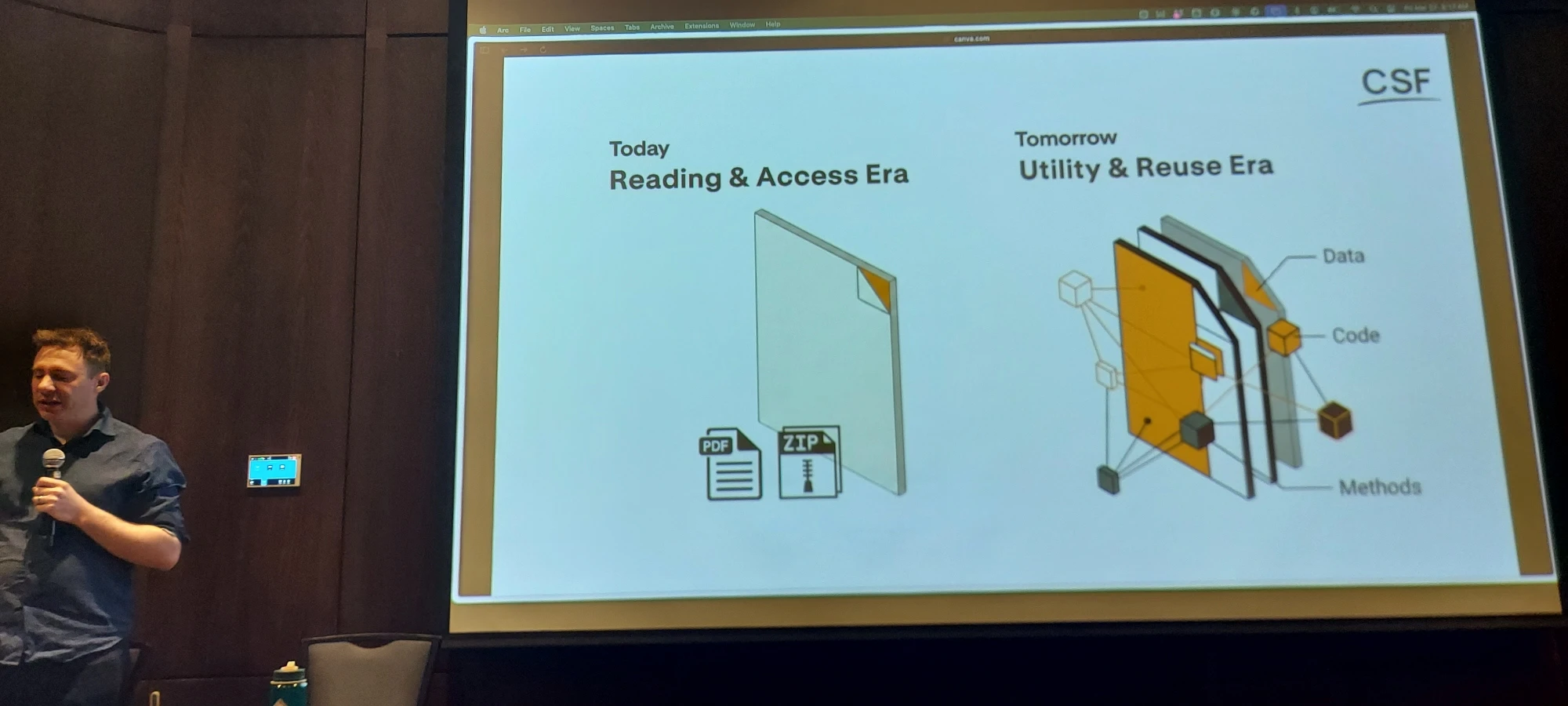 Rowan Cockett, CEO and a founder of Curvenote and founder of the Continuous Science Foundation, explaining the challenge atproto can solve during the ATScience keynote
Whether you have any idea how scientific publishing works, I urge you to watch the keynote: it's both important and quite entertaining. I particularly liked:
- Rowan's Lego metaphors for scientific data: "sometimes you need to empty all the buckets onto the floor and re-mix them", which is extremely difficult when each piece is published and stored in a different bucket (one repository for PDFs, another for data, etc.)
- how Discourse Graphs Project cofounder and Biology professor Matt Akamatsu, the joint keynote speaker, showed that if Rosalind Franklin would have gotten that Nobel if she had been able to publish her data onto the Atmosphere.
More:
- Rowen's blog (with video): Towards Modular Open Science
- ATScience agenda article
My only regret was that I was unable to reflect these ideas into my workshop, held a few hours later, as these insights would have made my model more interesting.
Data is everywhere now
Matt Akamatsu's presentation also mentioned something I heard many times in Vancouver: as ATProto data is easy to access and published using public lexicons, it is perfect for decentralised data management and sharing.
Emily Hunt's presentation on Friday afternoon presented a practical example. An astronomer at the University of Vienna, Emily had already demonstrated the power of custom feeds to communicate science to wider audiences.
!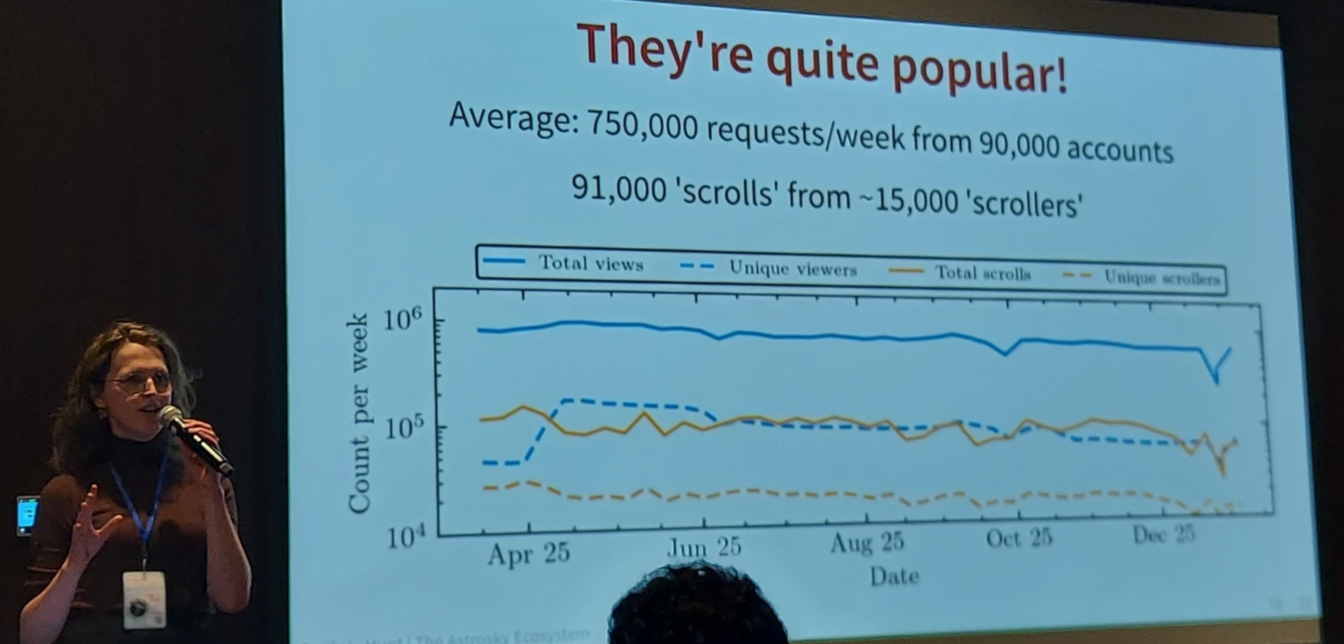
But in Vancouver she unveiled Nebra: software allowing scientists to stream time-critical scientific data live across the Atmosphere.
For astronomers, Nebra means more cost-effectively alerting telescopes around the world to focus on rare, blink-and-you'll-miss-it stellar events like supernovae. With Nebra, each telescope simply publishes its data, and everyone sees it practically immediately - there is no cumbersome, centralised alert system, acting as a single point of failure, sitting between them. As in so many fields, decentralisation equals resilience.
decentralisation equals resilience
But there must be thousands of other applications of this idea. I immediately saw this revolutionising citizen science, transforming each citizen scientist into a roaming data source: instead of uploading data into the single knowledge silo attached to the specific app they use, they'd instantly share data with the world as soon as they record it, allowing anyone to use it and combine it with other data, visualisation tools, and more.
More: it was only later that I connected this to Matadisco, published by the IPFS a couple of days before the conference: "An open, decentralized network for data discovery. Publish metadata about any dataset to AT Protocol. Build community portals. Find what matters."
Where are the journalists?
There was no shortage of sessions addressing exploring how ATProto could help the news industry: I greatly enjoyed and recommend Journalism must create its own algorithms and How and Why News Organizations Should Build on the ATProtocol
!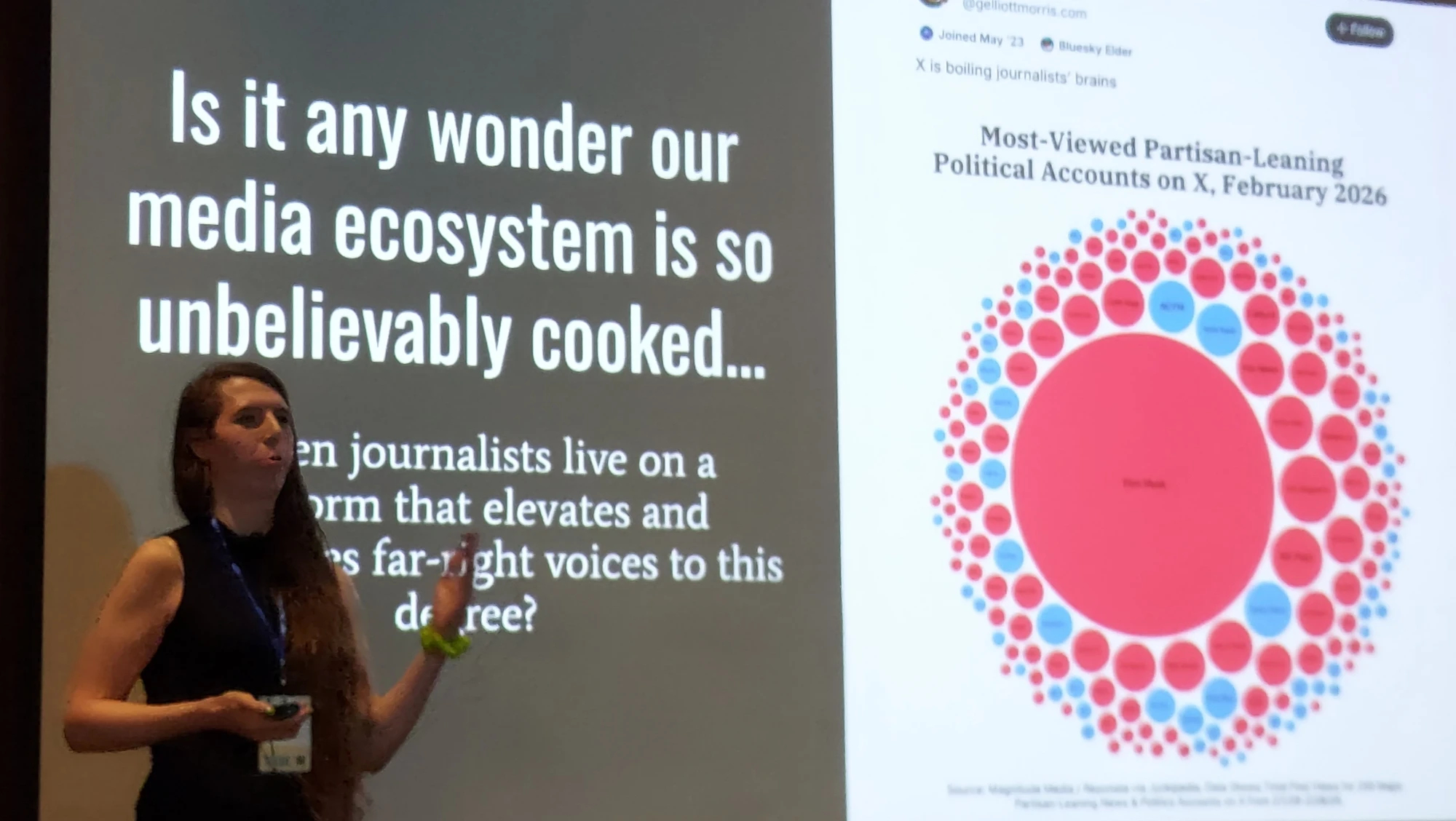
@Aendra preparing to unveil "A decade of algorithmic F*ckery" as well as new labellers (more slides)
In the sessions I attended, however, there were not many representatives from the news industry. As someone remarked: "the news industry feels that it's got one last shot, and it hasn't decided which one to take yet".
This resonated with me, given that my presentation at the Eurosky launch outlined some of the benefits ATProto offers the public, news and science sectors. Only the science sector seemed interested, however, which explains my presence in ATScience at Vancouver.
both news and science are about publishing knowledge they can back with evidence
But both news and science are, at their heart, about publishing knowledge they can back with evidence, and throughout the ATScience Day I saw applications developed for scientists and universities which would also work for journalists and newsrooms. Both the technology and the goodwill to use this technology to reinforce journalism are clearly in place, but the media must show up.
AI is everywhere (and not everyone's happy about it)
Time to tackle the elephant in the room.
The nature of ATProto data is not just good for science - it's also perfect input for AI models, so there were a number of truly interesting scientific applications marrying ATProtocol data with artificial intelligence.
The ones I actually managed to catch were:
-
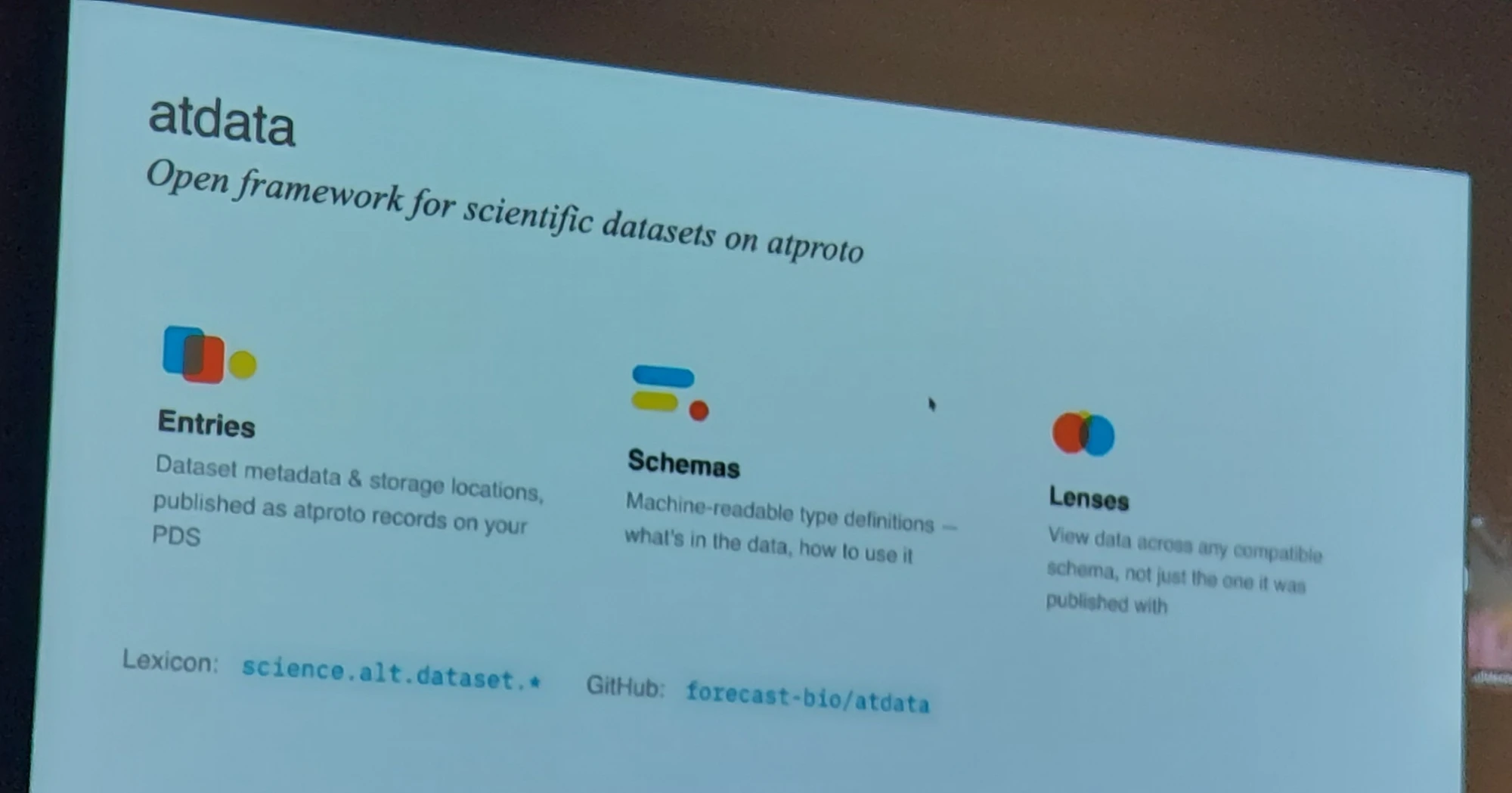
Building decentralized AI on atproto, which explored how a "protocol, not labs" mindset allows a 10-person organisation to compete with giants 1000x their size. (more shots here): !
-
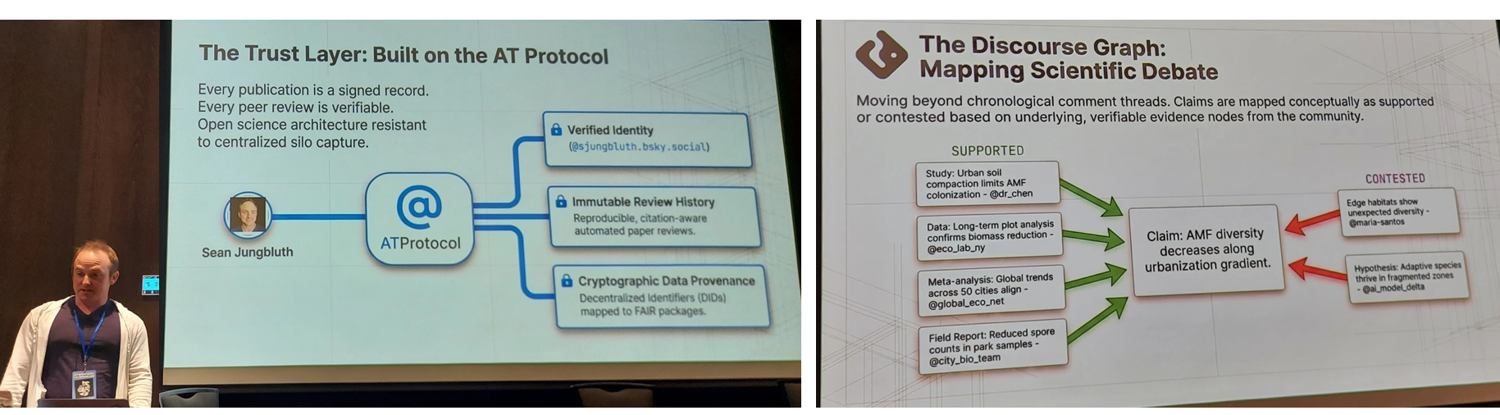
Reproducible, citation-aware automated paper reviews which integrates LLMs into biology experiments to both review and communicate results using, among other things, interactive storymaps (more slides): !
Sherlocking the ecosystem?
But the AI-related presentation everyone talked about was Attie, unveiled by Bluesky Social PPC as part of their "2026 Atmosphere Report" keynote on Saturday. Demonstrating Attie's ability to use AI to create custom feeds on demand was an unusual choice for two reasons:
- a lot of BlueSky users loathe AI; the comments online were predictably savage (it's been blocked more than the White House account)
- Attie represented a move by the dominant player in the ecosystem into a space already occupied by three startups, one of which (Graze.social) has been so successful that they even co-sponsored the conference.
This is called Sherlocking, or "ecosystem cannibalization" and it changed the conference vibe for me on the spot. Because if Bluesky Social had just torpedoed one of the ecosystem's most successful startups, they may have just made it extremely difficult for all the other startups in this space, due to investors' herd mentality. While everyone else was partying in central Vancouver, I ended up having a beer with fellow ASscience coorganiser Ariel Lighty and the CEO of Graze, and then spent the rest of the evening discombobulated in my room.
It's possible I took it a little too hard. Over the days that followed a number of smarter people than me set out their views, and it got to the point where I decided I didn't know what to think. I'm going to let this settle for a while, so for now I'll just link to some useful perspectives, and may return to this in the future:
- Marshmallow Test: Bluesky signals it's willing to eat its young
- A conversation with Ricardo and Bryan
- Bryan's thread on Sherlocking
- Ricardo's taxonomy of ATmosphere applications, which has gained a lot of traction since.
- The post-conference blog from new Bluesky Social CEO Toni Schneider, where he regrets that the presentation "felt more like a consumer product demo rather than the start of a conversation."
I probably shouldn't leave this blog post on a bum note. It was, after all, the most positive, wonderful, brilliant experience I've ever had at a conference in almost 40 years of professional life, and I know many other people feel similarly.
And there was of course much, much more in the programme. The above is only an early attempt to capture the major themes that stood out for me, and to which I'll probably return throughout the year. So if you'd like to know more, feel free to reach out (Bluesky, LinkedIn, ContactMe).
Revision Notes
This is one of this wiki's pages managed with the permanent versions pattern described in Two wiki authors and a blogger walk into a bar…
- changes in this version: (2026-03-06)
- none, as this is the first
- version control
- this is version: 1
- this is the current version: Five days in Vancouver
- here is the previous version: n/a