The Atmosphere as research infrastructure: ATScience workshop recap
!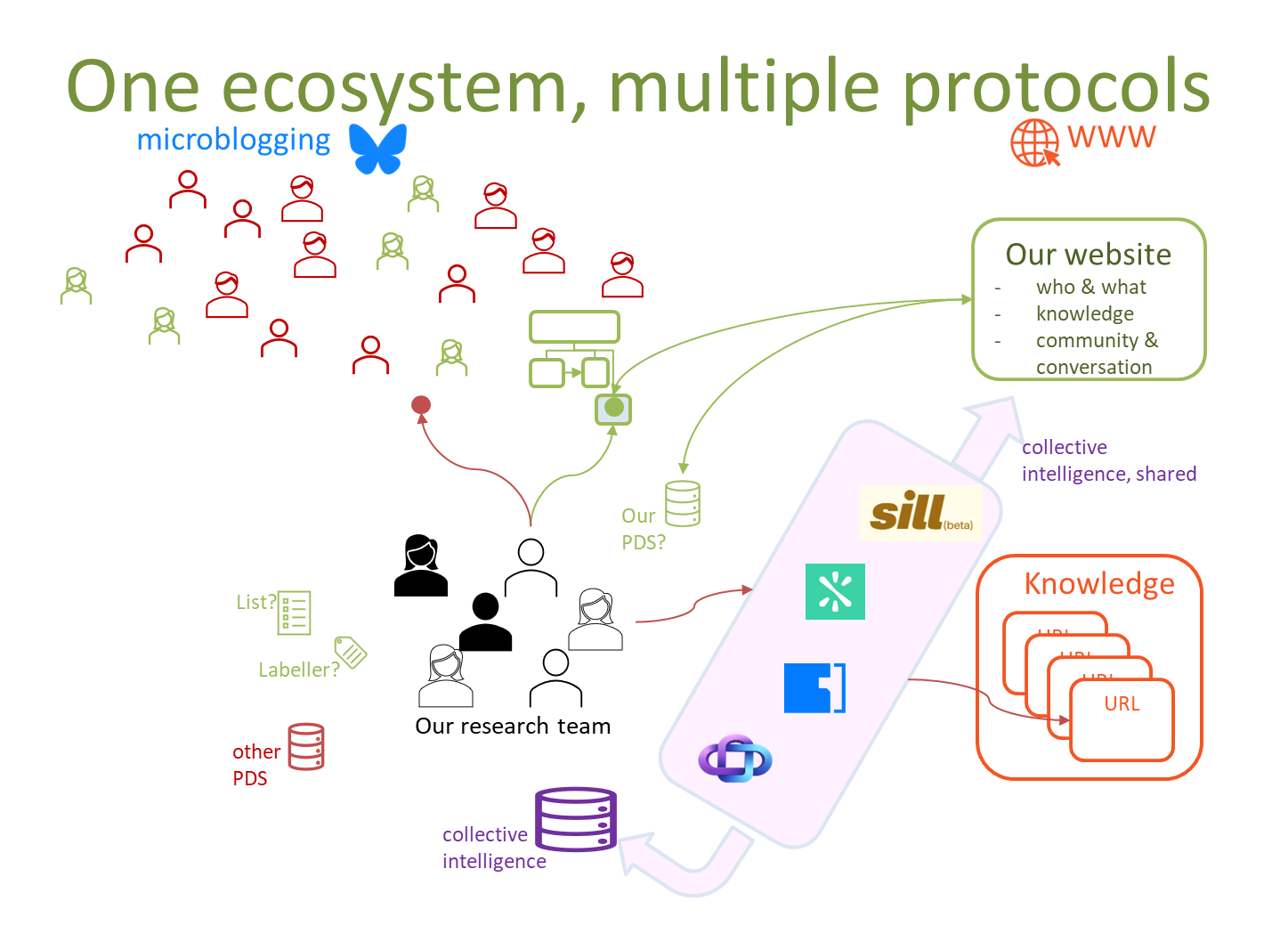 The ATprotocol offers us a social web of scientific knowledge, carried and created by the scientists themselves, supported by research institutions.
As my ATScience workshop in Vancouver wasn't streamed, I thought I'd throw together a quick video and publish some first thoughts and supporting notes, just to get a record of the content online before I turn to the rest of what was probably the best conference I've ever attended.
(This is version 3, published on my experimental wiki using the permanent versions pattern in the hope of collecting constructive criticism and ideas. Version control is in the footer.)
Too long, didn't watch?
I think the workshop went pretty well, but only after Ariel and Ted carved out some space in the lounge to allow us to hold it, and because Cosmik Network shelled out for a monitor to present from (thanks everyone!).
The audience seemed to know their way around the Atmosphere, so - contrary to the workshop programme I published a few weeks ago - we skipped the "Intro to atproto" and jumped straight to the core question: how and why can research teams integrate their website and Atmosphere apps to improve science comms, collective knowledge discovery, sensemaking, and collaboration?
creating and sharing collective knowledge from individual researchers' activities
The video, below, makes the following argument:
- each research team website can derive collective knowledge from the individual researchers' activities across the Atmosphere (networking, publishing, curating, commenting...)
- standard.site allows each research team to upgrade their website into scaffolding for the researchers' activities
- and then amplifies it: each website is a node in the Atmosphere, and so can be connected like Lego bricks, creating new structures to support global knowledge discovery, sensemaking, and collaboration.
It's worth noting that this is not limited to research teams: any organisation interested in knowledge can do this (looking at you, News).
As an added bonus, we collectively transform the Web into the largest recruitment surface for the Atmosphere. Like many of the applications discussed throughout ATScience Day, this idea seemed to resonate throughout the rest of the Atmosphere conference, particularly after attendees realised that the Atmosphere would not grow in the way many of us had previously thought (more on that in a later post).
Video & background
This video is a hastily thrown-together combination of:
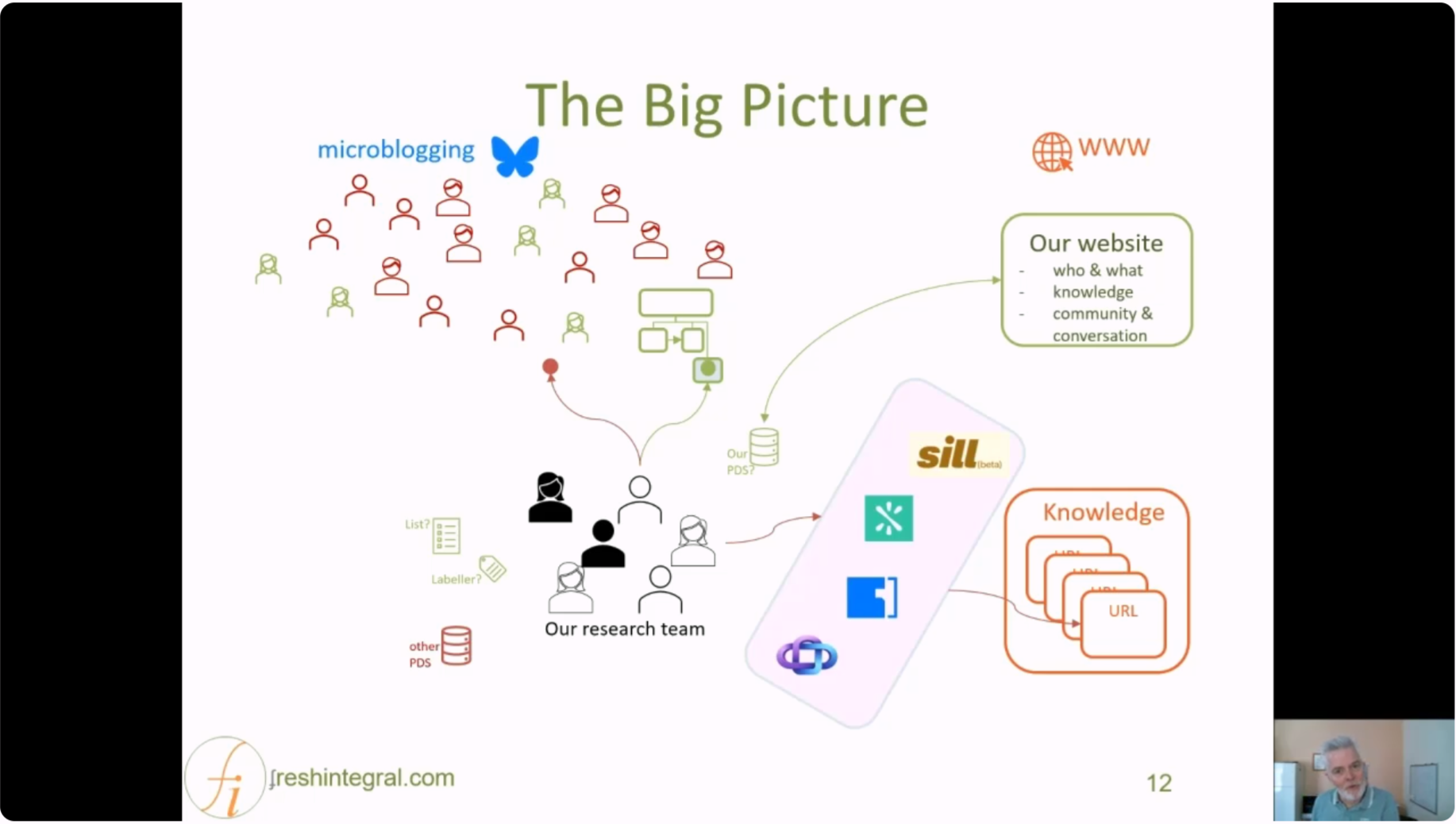
- a slidecast of the workshop's first, "scene-setter" presentation, which I shared with the other speakers before the event so they'd understand the framing (0:40-6:10)
- an explanation of the other contributions to the workshop from myself and the three founders who joined m: Brendan of Leaflet.pub, Tyler of Sill.social, and Wesley of Semble.so.
Below you'll find links to explore the background further.
Win-Win One: Starter packs & custom feeds (me, 6:10–7:12)
After the scene setter, I kept the imaginary microphone to summarise the presentation I gave in Berlin last November at the Eurosky launch. The core argument then was that Bluesky starter packs and custom feeds let institutions build structures on Bluesky which are useful to both them and their individual researchers.
I opened with this because it was an early example of the win-wins I wanted to explore throughout the workshop:
- The institutions have the resources to build and maintain structures on the Atmosphere, so these structures must benefit the institution
- But these structures are only useful if the researchers use them, so they must also benefit individual researchers
- The fact that researchers can take their network and content with them when they change institution is therefore essential.
Every university should be doing this already, particularly as it's just the first rung on a very rewarding ladder. Here's the next:
Websites just got social (Brendan, 7:12 - 8:25)
Shortly after Berlin, Leaflet.pub and two other companies launched standard.site — a lexicon that allows websites to appear natively in the ATmosphere. As a result, two open protocols can now cooperate: http, which underpins Web publishing, and atproto, which underpins the social Atmosphere.
In other words, websites can be social now: your institution no longer has to rely on Twitter, Facebook, or LinkedIn to host conversations about its content. Instead, you can integrate your website directly into the social conversation on the ATmosphere, bringing the discourse back to where the content lives rather than scattering it across platforms you don't control.
More: Shortly after my workshop, Brendan ran an entire workshop dedicated to Atmospheric Publishing, so I was extremely grateful that he found the time to contribute to mine.
Example: event co-creation (me again, 8:25-14:52)
I then took the floor again briefly to show what this could look like in practice — drawing on a short blog post that itself summarises and generalises a four-part series on co-creating physical events with your online communityby integrating the Atmosphere with your website.
The key points are summarised in the above post, but they're worth repeating - integrating ATProtocol with your website:
- lets you build powerful, interactive online communities with very simple code
- while giving you in-built reach to 40+m users across the Atmosphere
- and allowing your members to own and manage their own data.
And because the website uses ATmosphere accounts, everyone signing up to it will discover that their account unlocks all of the other websites using this approach, and every app on the Atmosphere.
The resulting virtuous cycle is the best way we have of going from 40 million to 400 million Atmosphere users.
The more sites that do this, in other words, the more Atmosphere accounts will be created, in turn making it more valuable for other websites to do this and new apps to launch. The resulting virtuous cycle is probably the best way we have for growing from 40 million to 400 million Atmosphere users.
Collective listening: from Sill to "Our Sill" (Tyler, 14:52-15:47)
Sill is part of my daily routine. It watches what the people I follow are sharing and discussing across Bluesky and delivers the most popular links as a morning email digest, turning my social graph into a content discovery tool.
At the workshop, Tyler went further than any slidedeck could: he demoed Our Sill, showing what Groups would look like within his app. Take a research team, combine their social graphs, and see what the people they collectively follow are reading and talking about. That's collective listening.
More: Tyler spoke in two other Atmosphere sessions:
- How and Why News Organizations Should Build on the ATProtocol
- Rethinking the Client: Why User Choice is the Key to Growth for ATProto
Collective curation: Adding Groups to Semble (Wesley, 15:47-16.47)
Semble.so is a curation tool that lets you curate collections of content, either for yourself, or as open collections anyone can contribute to. The Cosmik Network team behind it organised the entire ATScience Day, and the tool is developing fast.
At the workshop, Wesley led a discussion on how Groups could provide a third type of Semble collection, allowing a research team to collaborate on curating resources while ensuring those outside the team could not contribute to it.
Where Tyler's demo showed collective listening, in other words, Semble Groups would enable collective curation: the team's shared judgement about what's worth reading, made legible and useful rather than scattered across individual bookmarks. The resulting team knowledge base could remain private, or published via Semble and/or the research team website mentioned earlier, where it could be remixed with others.
More: Wesley and Ronen from Cosmik also spoke at:
- Semble: A social knowledge network for research on ATProto
- Semble: Rediscovering the Magic of Trails
The missing piece: Skysquare
Another founder, Travis Simpson of Skysquare was also going to take part, but he fell ill in Vancouver and couldn't attend. He did, however, provide a video for the session he was going to give earlier that day.
As you can see, Skysquare is another take on Web-Atmosphere integration, turning the web into a socially annotated commons, providing another way the above model could allow a research team to transform its members' individual activity into collective knowledge and sensemaking.
Conclusion (16:47-18:31)
I'll close with the key points from the last ~100 seconds:
- The entire ATScience Day (Friday) was amazing, so I hope to follow up with more blog posts, in cooperation with the rest of the ATScience team
- From the way people talked about ATScience throughout the rest of the weekend, it's clear that the science sector is at the forefront of exploring the potential of this protocol
- For me the most significant development is the above-mentioned integration between the Web and the Atmosphere. This will give the Atmosphere a huge boost, probably square the value of the Web, and is our best shot at helping people migrate away from US big tech legacy social media.
And that is something worth fighting for.
Revision Notes
This is one of this wiki's pages managed with the permanent versions pattern described in Two wiki authors and a blogger walk into a bar…
- changes in this version:
- version control
- this is version: 3
- this is the current version: The Atmosphere as research infrastructure
- here is the previous version: The Atmosphere as research infrastructure 2